












The ozone you can't see is the one that hurts you

You've heard ozone protects us. That's true; 30 kilometres up. At street level, it's doing the opposite. And it's getting worse.

Most people associate ozone with protection, that thin atmospheric shield deflecting ultraviolet radiation. It’s one of the more reassuring facts most of us carry from school. But there’s another ozone story, and it plays out not in the stratosphere but in the air around us: on busy roads, in industrial corridors, in the parks where children play on summer afternoons.
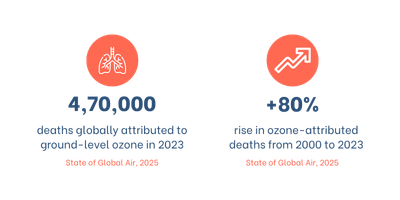
Ground-level ozone is invisible, odourless, and undetectable without instruments. It doesn’t announce itself the way smoke does. It doesn’t sting the eyes like smog. It simply accumulates: in the lungs, in hospital statistics, in crop yields; quietly compounding a public health burden that has grown by more than 50% in just two decades.

This is a story about what we’re not measuring, what we’re not seeing, and why that needs to change.

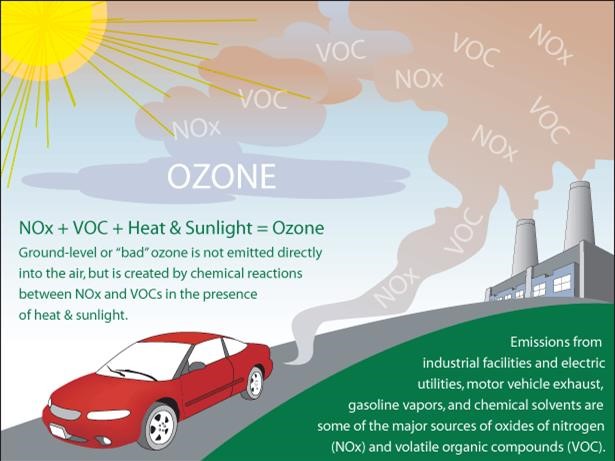
The chemistry of a slow emergency
 

What ozone does to a body
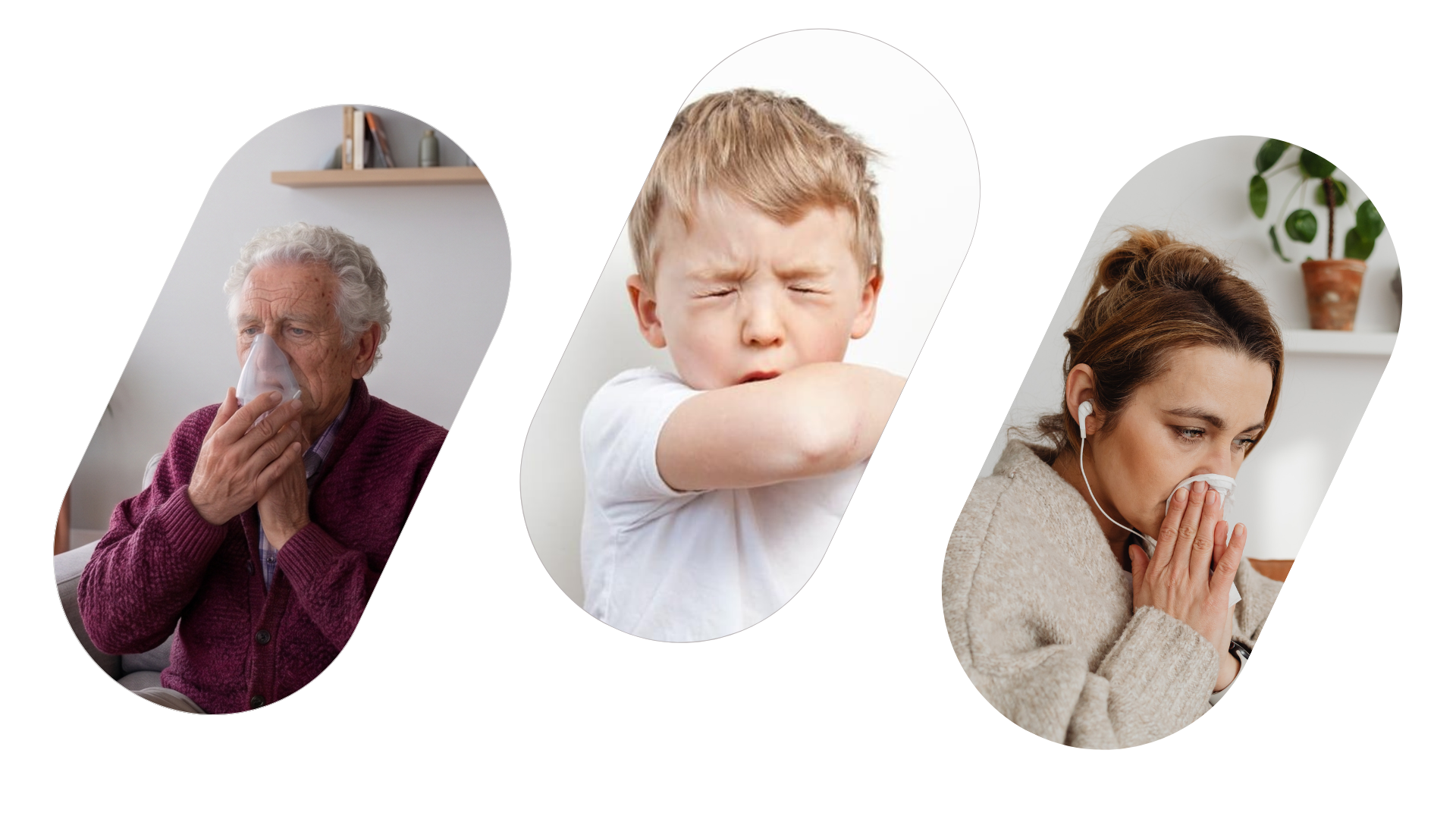
 

The effects are not dramatic in the way a chemical exposure might be. There’s no visible injury. Instead, ozone works on the respiratory system over time, inflaming the airways, reducing lung capacity, and making the body more vulnerable to infection.

Short-term exposure — even a single hour at elevated concentrations — can trigger measurable physiological responses. Repeated exposure, over weeks and years, is linked with the development of COPD (Chronic Obstructive Pulmonary Disease): progressive, irreversible, and disabling. In children, whose lungs are still developing, chronic ozone exposure may permanently stunt lung growth. In older adults, it accelerates respiratory decline that was already underway.
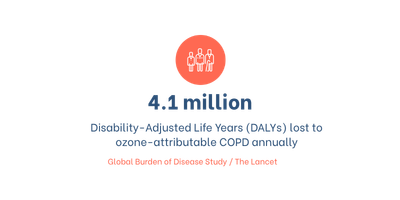


The disease burden of ozone has surged by more than 50% in two decades — from 261,000 deaths in 2000 to 470,000 in 2023. That escalation is not primarily because ozone concentrations have spiked everywhere.It reflects the interaction of rising exposure with an ageing global population. Ozone hits older, already-vulnerable respiratory systems hardest, and the world has more of them.

A crisis without borders — but not without patterns

Ground-level ozone does not respect geography. It is a global pollutant with a global death toll — but the burden is not evenly distributed, and understanding where it concentrates helps explain why the urgency is growing in specific regions faster than others.

India and China together account for approximately 70% of the total global mortality burden from ozone exposure — a consequence of their combination of high ozone concentrations, elevated COPD death rates, and enormous populations. But the crisis extends well beyond Asia. 

A modelling study published in The Lancet Planetary Health found that ozone-attributable mortality worldwide increased by 46% between 2000 and 2019, spanning urban, peri-urban, and rural areas across 12,946 cities. This wasn’t a story confined to megacities or industrial zones — it played out in mid-sized towns, agricultural regions, and suburban corridors where monitoring infrastructure is thinnest and public awareness lowest. 

In scenarios where both climate policy and air quality regulations remain weak, ozone-related deaths are projected to increase by as much as 94% by the 2050s — a number that spans continents. South Asia shows the steepest trajectory, but the United States has one of the highest ozone-attributable disease burdens among high-income countries, and Europe’s ageing population faces compounding vulnerability as summer heat events grow longer and more intense. 

Global risk assessment modelling estimates yield losses of staple crops between 3 to 16% from ozone exposure, causing economic losses of between US$14 to 26 billion in the year 2000 alone — figures that have only grown since. The regions most affected include the US Midwest, much of Europe, the Indo-Gangetic Plain in South Asia, and the eastern coastal region of China: the breadbaskets of the world, quietly losing productive capacity to a pollutant most farmers have never heard of. 

What connects all these geographies is the same underlying gap: ozone is rising, its health and agricultural consequences are well-documented in research, yet the monitoring infrastructure needed to translate that science into local, actionable data remains absent across vast stretches of the globe. The crisis is global precisely because the blind spot is global. 

The invisible threat has a visible solution

Ground-level ozone is not a new problem. The science linking it to COPD, respiratory impairment, crop damage, and premature death has been accumulating for decades. What’s new is the urgency: a 50% increase in the global death toll in twenty years; a trajectory, without intervention, of further escalation.

The gap between what guidelines recommend and what communities are actually breathing will not close through awareness alone. It closes through measurement — granular, reliable, continuously updated data that transforms ozone from an abstract risk into a manageable one.

The ozone you can’t see is real. But it is not, with the right infrastructure, invisible.

Want to understand ozone monitoring at the community scale?

Acoem’s Serinus 10 Ozone Analyser is built for precise, real-time, location-specific ozone data that can anchor both regulatory compliance and community health decisions.

Using UV photometric technology — specifically non-dispersive ultraviolet absorption — the Serinus 10 delivers stable, high-selectivity measurements with low detection limits.

Explore how the Acoem Serinus 10 Ozone Analyser is helping authorities, city planners, and research institutions build the data infrastructure that turns air quality compliance into community health action.

Learn more about Serinus 10 Ozone Analyser

 KEY SOURCES

  • State of Global Air (2025). Ozone: Global Health Impacts. https://www.stateofglobalair.org/pollution-sources/ozone
  • The Lancet Planetary Health (2022). Global trends in ozone concentration and attributable mortality, 2000–2019.
  • Yale School of Public Health (2024). Ozone-related deaths projected to rise without stricter climate, air quality controls.
  • World Economic Forum (2023). What is surface ozone pollution and how it’s affecting India?
  • The Royal Society – Philosophical Transactions A (2020). Effects of ozone on agriculture, forests and grasslands.
  • ScienceDirect (2024). Impact of ozone pollution on crop yield, human health, and associated economic costs in the Indo-Gangetic plains.
  • Global Burden of Disease Study (2015/2019). Estimates of disease burden attributable to ambient air pollution. The Lancet.


!
by Harsh Dixit | | May 6, 2026
Share :

View our resources

Visit our library of educational videos, podcasts and more.

View more

Suscribe to the blog

Ici formulaire à venir

Would you like to...?