













Smarter jaw crusher maintenance - Don’t let downtime jam your operations

Jaw crushers are critical workhorses, breaking down ore, slag, and scrap metal under extreme conditions. Operating in dusty, high-vibration environments, they face constant mechanical stress, making wear and unplanned downtime costly. Predictive maintenance transforms this challenge into opportunity, leveraging real-time data and AI to anticipate issues, reduce downtime, and optimize operations.

Jaw crushers play multiple roles across processing:

  • Ore Processing: Reduce large ore chunks for downstream refinement.
  • Slag Crushing: Break down post-smelting waste for residual metal recovery.
  • Recycling: Process scrap metal and electronic waste into manageable fragments.
  • Tramp Metal Protection: Guard magnets detect unwanted debris, protecting equipment and staff

Types of Jaw Crushers

  • Single-Toggle: Efficient for moderately hard materials, general-purpose crushing.
  • Double-Toggle: Handles extremely hard or abrasive materials, delivering high crushing force for steel slag or iron ore.

The importance of predictive maintenance for jaw crushers

In operations, unplanned downtime can cost thousands per hour. Predictive maintenance shifts from reactive or scheduled approaches to proactive monitoring, using sensors to detect issues early. This is vital for jaw crushers, where failures in bearings, motors, or lubrication can halt production.

By targeting repairs precisely and avoiding catastrophic failures, predictive maintenance can reduce maintenance costs by up to 30%. For a major iron ore producer, this approach led to a 28% reduction in maintenance costs over two years by eliminating unnecessary repairs and preventing secondary damage.

Data collection and continuous monitoring of jaw crushers.

  • Vibration: Sensors on bearings and the pitman assembly detect patterns that may indicate looseness, misalignment, or wear.
  • Temperature: Monitored on bearings and lubrication systems, this data flags friction or failure risks from poor lubrication.
  • Lubrication: Analysis of oil or grease checks for contamination, viscosity, and metal particles, which signal internal wear.
  • Power Draw: Tracks motor efficiency; sudden spikes can indicate increased friction or mechanical issues. This can also lead to a 5-10% reduction in energy consumption for the crushing process..

Analysis and insights

The collected data is analyzed using patented AI  to provide actionable insights.

  • Data Analysis and Machine Learning: Algorithms establish baselines from historical data, flagging anomalies as they occur.
  • Diagnostic Assessment: Identifies the root cause of the issue, such as a specific bearing failure.
  • Prognostic Assessment: Forecasts the remaining useful life (RUL) of components, allowing maintenance teams to plan repairs precisely and extend the equipment’s lifespan by 20% or more. For a jaw crusher, this could mean adding 2-3 years of productive service life, representing significant capital expenditure savings.

Acoem’s comprehensive solution portfolio

Acoem’s predictive maintenance strategy for jaw crushers and other heavy machinery is built on a layered portfolio of technologies. This integrated approach combines robust data collection with intelligent analysis to deliver actionable insights, transforming maintenance from a reactive process to a proactive one.

The foundation of the portfolio is Acoem’s suite of wireless sensors, which are designed to operate reliably in the harsh, dusty, and high-vibration environments of industries. These wireless systems ensure that data is collected in real-time, providing an up-to-the-minute picture of the crusher’s health without requiring manual inspections.


Eagle: Wireless Condition Monitoring System

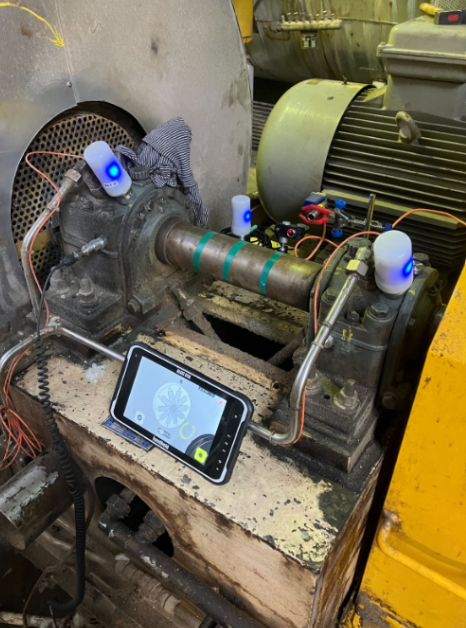
The Eagle system brings your most remote, hard-to-reach & hazardous assets’ health to your fingertips without the need for ladders or permits. It is essential for monitoring subtle changes in a jaw crusher’s vibration signature, such as those caused by incipient bearing or gear damage. Its wireless nature eliminates the need for extensive cabling, simplifying installation and reducing safety risks.

  • Wireless, triaxial sensors with piezoelectric technology offer extensive monitoring range for early fault detection.
  • Ideal for maintenance and reliability teams requiring frequent machine condition monitoring beyond routine routes.
  • Combine these sensors with a handheld data collector and continuous monitoring system for comprehensive plant coverage, all analyzed in NEST i4.0.

MV-x: Online Condition Monitoring System

The MV-x system offers versatile configurations for synchronous data collection, ranging from 6 to 32 channels per device, enabling comprehensive monitoring capabilities across various assets on the plant floor. The MV-x system offers adaptable monitoring solutions for diverse assets, ranging from complex machinery to critical components.

  • What sets the MV-x apart is its advanced capability to detect and differentiate between the high-impact vibrations of the crushing process itself and the distinct, subtle vibrations that signal an actual fault in components like bearings or gears. This is critical for preventing false positives and ensuring accurate diagnostics.
  • The system can also monitor machines operating at variable speeds, automatically adapting its data acquisition strategy and alarm thresholds to match the current operating conditions.

NEST Vision – Predictive Maintenance Dashboard

Visualize data, trend issues, and receive actionable data on the health of your equipment in this comprehensive maintenance management dashboard. Experience simplicity with NEST Vision – your all-in-one dashboard for streamlined monitoring solutions. This web-based application serves as a unified view to monitor the condition of your rotating machinery.

A Real-World Case Study: Motor Bearing Damage in a Jaw Crusher

In a metal mining operation, Acoem’s MV-X detected early signs of trouble in a jaw crusher’s motor. The vibration data showed clear anomalies in the motor’s bearings, indicating the outer race was beginning to fail.

The system’s analysis and recommendations were clear: inspect the motor and, if necessary, replace it during the next scheduled maintenance period. This proactive step, costing an estimated $15,000, prevented a potential catastrophic failure that could have caused an unexpected shutdown. Had the failure occurred, it would have resulted in an estimated $75,000 in lost production and secondary repair costs.

In the metal industry, adopting predictive maintenance for jaw crushers is no longer just an option—it’s a strategic necessity. By leveraging sensor-driven, AI-enhanced solutions, companies can dramatically reduce unplanned downtime, cut maintenance costs, extend asset life, and improve overall operational safety. This transformation turns maintenance from a reactive cost center into a powerful driver of efficiency and profitability

Ready to Crush Your Downtime?

Connect with Acoem's experts to see how smarter maintenance can transform your operations and boost profitability.

Get a Free Consultation
by Mithun Gore | | September 29, 2025
Share :

View our resources

Visit our library of educational videos, podcasts and more.

View more

Suscribe to the blog

Ici formulaire à venir

Would you like to…?