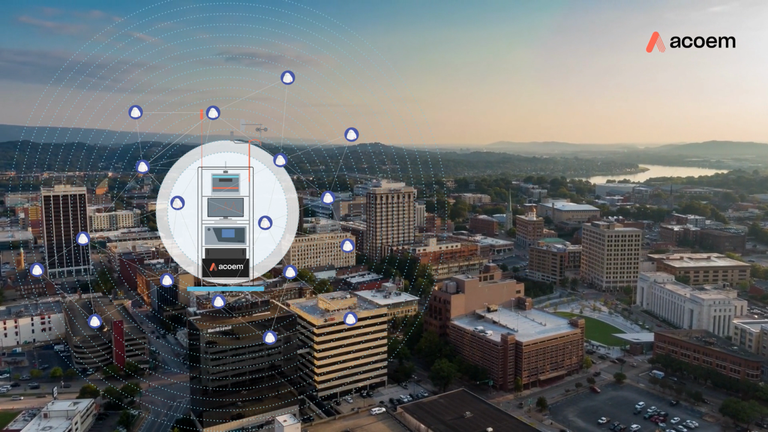











Imagine two cities. In one, the population is suffering from exposure to diesel exhaust. In the other, they are breathing smoke from burning crop residue. But the monitor may show the same PM2.5 number for both.
The number alone cannot tell you which problem you have, so you can apply the appropriate solution
That gap is where Black Carbon (BC), the sooty part of combustion smoke, comes in. In alignment with the WHO recommendations, the EU has updated its Ambient Air Quality Directive (AAQD) in 2024 to add BC and ultrafine particles to the routinely measured PM10 and PM2.5 [1].
The regulatory blindspot: Weight vs. Composition
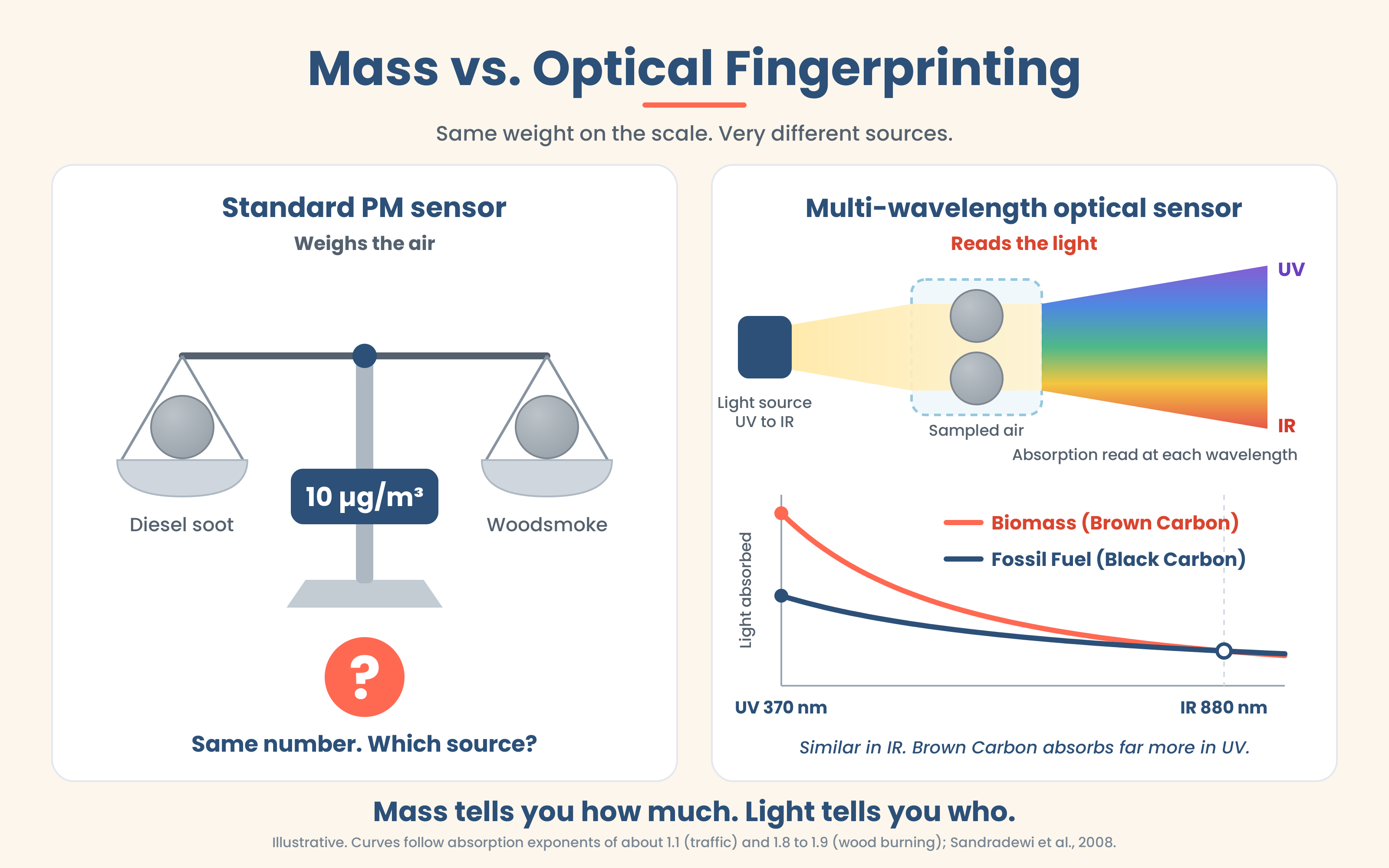
For decades, air quality frameworks have relied on total particulate mass: how many micrograms of dust, aerosol and soot sit in a cubic metre of air.
The limitation is simple. A mass-based monitor is colour-blind. A microgram of harmless sea salt or mineral dust weighs exactly the same as a microgram of soot that warms the climate.
The total particulate mass concentration number, leaves environmental agencies and industrial operators guessing who or what generated the plume. Without knowing the source, policy interventions become a game of trial and error.
Black vs. Brown Carbon: The forensic science of smoke
To unmask the true culprits behind urban pollution, atmospheric scientists rely on the distinct optical properties of two carbon sub-types: Black Carbon and Brown Carbon.
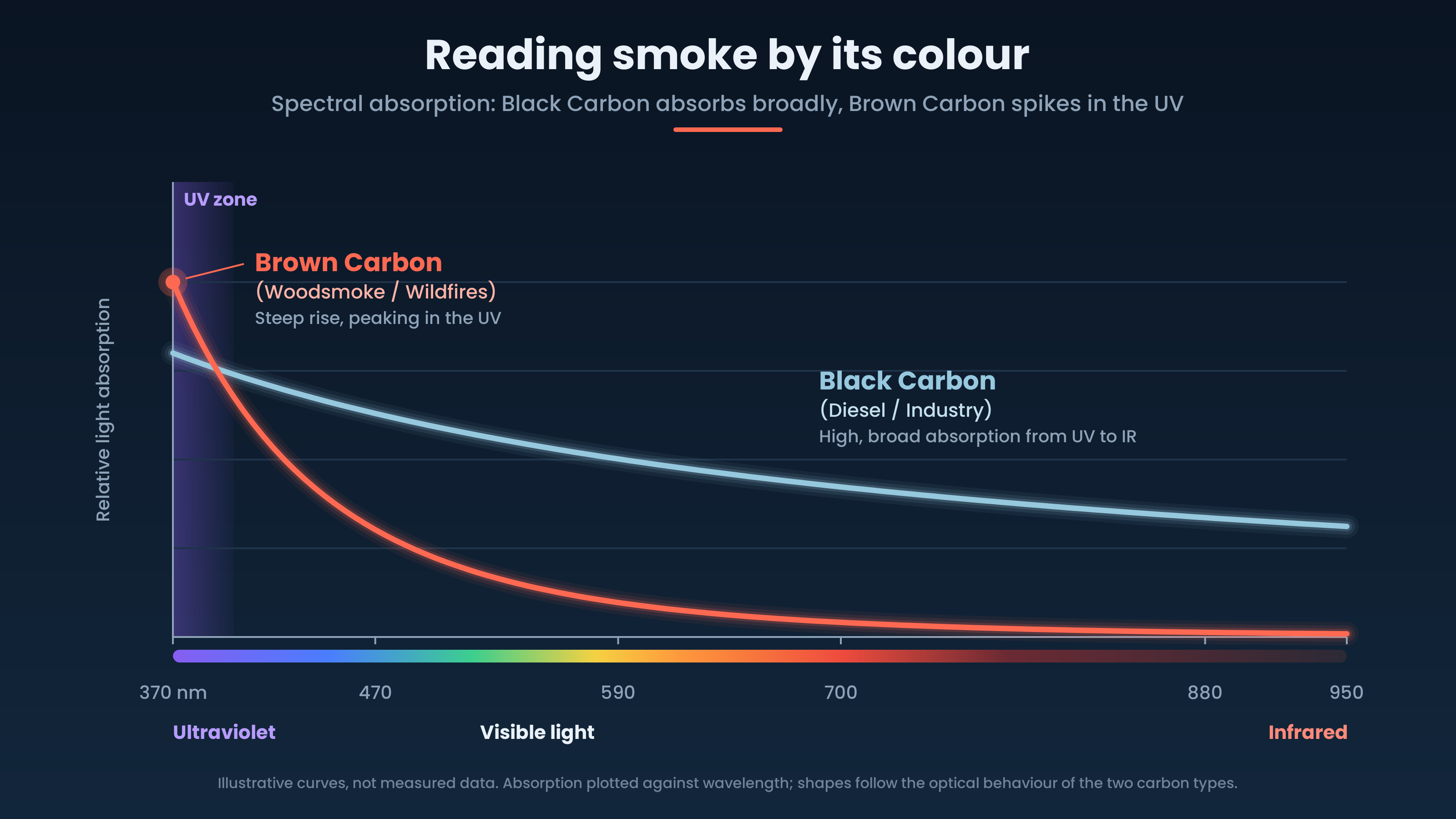
- Black Carbon forms through high-temperature, incomplete combustion of fossil fuels, biomass, and waste ,It is a powerhouse light absorber, absorbing solar radiation almost uniformly across the entire light spectrum, from ultraviolet (UV) through visible light and into the near-infrared (IR).
- Brown Carbon is generated by lower-temperature combustion—including wildfires, agricultural crop burning, and residential wood heating. It consists of organic compounds that, unlike BC, exhibit a steep spike in light absorption at shorter, ultraviolet wavelengths while absorbing very little in the infrared range.
Because these two pollutants interact with different colors of light in predictable, measurable ways, multi-wavelength optical analysis acts like a forensic fingerprint. By illuminating sampled particles across multiple distinct wavelengths—from UV to IR—advanced analyzers (such as the 10-wavelength Acoem Met One BC 1054 or dual-wavelength BC 1060 and C-12) can separate fossil fuel emissions from biomass burning in real time.)
From scientific advantage to regulatory reality
Until recently, separating Black Carbon from Brown Carbon was largely the domain of atmospheric researchers and forward-thinking municipalities. That is changing rapidly.
Under the revised EU Ambient Air Quality Directive (Directive (EU) 2024/2881), Black Carbon is officially moving from an emerging pollutant of concern to a mandatory monitoring requirement at both urban and rural background supersites across member states. Historically, European air quality legislation has served as a powerful catalyst for regulatory shifts worldwide—meaning what starts as a compliance mandate in Europe often sets a new standard for global monitoring networks and emerging industrial hubs.
As compliance timelines tighten, the challenge for environmental agencies, researchers, and industrial operators isn’t just measuring Black Carbon—it is building intelligent networks capable of pinpointing its exact sources so targeted action can follow.
Implications for public authorities and private sector
The compliance with this revised legislation will equip stakeholders with advanced frameworks and monitoring tools to actively drive air quality improvements. By upgrading monitoring infrastructure and urban planning strategies, both the public and private sectors gain the actionable data needed to build healthier, more resilient communities.
- Cities and municipalities will be empowered with data to design highly targeted, effective, and evidence-based clean air strategies.
- Businesses and industries will benefit from clearer metrics, providing a predictable environment to optimize operations, drive green innovation, and showcase their sustainability leadership.
- The transport and mobility sector will gain a clear regulatory roadmap that accelerates the transition toward smart fleet electrification and modern, optimized urban mobility networks.
Where does global air quality policy go from here?
Navigating the transition from traditional particulate monitoring to source-apportioned Black Carbon tracking raises critical questions for regulators and network operators alike.
To unpack the revised EU Ambient Air Quality Directive—and explore what these changes mean for air monitoring networks across the rest of the world—join Acoem’s upcoming live session, Black Carbon at the Crossroads: The New EU AQ Mandate & What It Means for the Rest of the World.
Join me for a live session
If you want to explore how evolving EU mandates are shaping global monitoring networks—or have specific questions about deploying multi-wavelength optical monitoring—I invite you to join me for our upcoming live webinar, Black Carbon at the Crossroads: The New EU AQ Mandate & What It Means for the Rest of the World.
Drawing on my two decades in atmospheric research—including my work at the Max Planck Institute for Biogeochemistry and international projects like ICOS and the Amazon Tall Tower Observatory—I will walk through the technical advantages of real-time eBC measurement, share regional case studies, and host a live Q&A.
Live Webinar Series • Interactive Q&A
Black Carbon at the Crossroads: The New EU AQ Mandate & What It Means for the Rest of the World
Select the session tailored to your region below to reserve your seat:
-
-
North & South America
Tuesday, 1 December 2026 • 1:00 PM EST / 10:00 AM PST / 3:00 PM BRT
Register for the Americas Session →
-
-
-
Europe, Middle East & Africa
Wednesday, 2 December 2026 • 2:00 PM CET / 1:00 PM GMT / 5:00 PM GST
Register for the European Session →
-
-
Asia-Pacific & Australia
Thursday, 3 December 2026 • 10:30 AM IST / 1:00 PM SGT / 4:00 PM AEDT
Register for the Asia / Australia Session →