












Belt Alignment Best Practices for Maintenance Teams

Alignment of belt-driven machines, whether fitted with V-belts or synchronous belts, needs to be performed to ensure equipment reliability, minimise downtime, and prevent unplanned maintenance. In some industries, belt alignment is still dismissed under the assumption that "the belt can handle it," or alignment is carried out by improperly trained maintenance personnel. This is not the case.

Know the types of belt-driven misalignment

There are 3 axes of belt misalignment, which are the Vertical angular misalignment, Horizontal angular misalignment, and Offset misalignment.
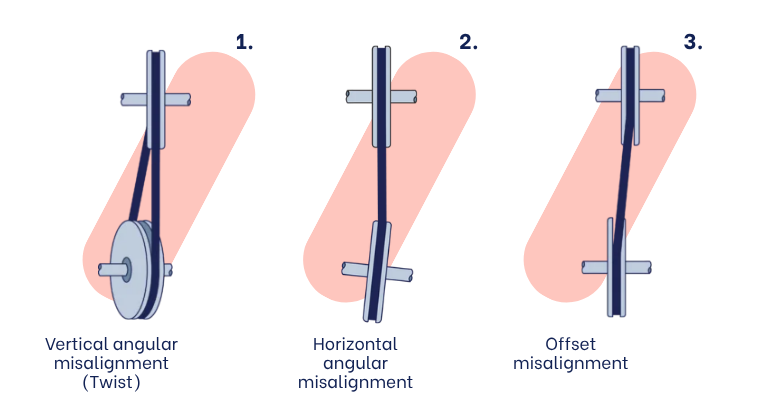
1. Vertical angular misalignment (Twist)

This occurs when the pulleys or sheaves are angled in the vertical plane ; one pulley is tilted up or down relative to the other.
This condition causes the belts to enter and exit at an angle, leading to uneven tension, edge wear, and reduced drive performance.

2. Horizontal angular misalignment

This occurs when the pulleys are angled in the horizontal plane; one pulley is rotated slightly compared to the other.
This condition creates a “V”-shaped belt path that results in side loading, vibration, and accelerated belt and sheave wear.

3. Offset misalignment

This occurs when the pulleys are on parallel shafts but are not “inline” with each other ; one pulley is positioned too far in or out on the shaft relative to the other.
Offset misalignment causes belts to run off-centre, increasing the risk of slippage, uneven loading, and premature belt wear.

Why should you perform belt alignment?

Proper belt alignment ensures efficient power transmission, reduces wear on components, and prevents costly unplanned downtime. By aligning belts and pulleys correctly, you extend the life of your equipment and improve overall reliability.

Seven benefits of precision belt alignment

  1. Reduces downtime
    Misalignment leads to premature belt failure and sheave/pulley wear; proper alignment keeps machinery operating longer between maintenance intervals.

  2. Extends belt and pulley life
    Aligned components experience reduced friction and uneven wear, resulting in longer-lasting belts and sheaves/pulleys.

  3. Improves energy efficiency
    Proper alignment minimises slippage and drag, reducing power consumption and running costs.

  4. Reduces vibration and noise
    Misaligned belts often cause excessive vibration and squealing; correct alignment ensures quieter and smoother operation.

  5. Minimises unscheduled stops
    Prevents sudden breakdowns by addressing alignment issues before they cause critical failures.

  6. Protects bearings and shafts
    Reduces side-loading on shafts and bearings, lowering the risk of secondary mechanical failures.

  7. Improves workplace safety
    A properly aligned system is far less likely to throw belts or fail unexpectedly, creating a safer working environment.


Correct order for fixing 3 axes of misalignment

When carrying out a belt alignment, the three axes of misalignment must be corrected in the following sequence:

  1. Vertical angular misalignment

  2. Horizontal angular misalignment

  3. Offset misalignment


Step 1:
Vertical angular misalignment

It is corrected by shimming either the front or rear feet of the electric motor.
The goal of this step is to only get the sheaves parallel to each other in the vertical plane.

If using a PAT alignment tool, when the vertical angle is corrected, the laser beam will be on the same graduations on the top and bottom of the scale on the target face of the PAT  mounted on the electric motor sheave.

Step 2:
Horizontal angular misalignment

Correct this by adjusting the rear feet of the electric motor horizontally (side to side).
This positions the sheaves parallel to each other in the horizontal plane. At this point, the machine shafts will also be parallel in the vertical plane.

If using a PAT alignment tool, adjust the motor’s rear feet so the “movable” laser beam sits on the same colour panel and graduations (top and bottom) on the opposite “stationary” target as the stationary laser beam does on the movable target face.

Step 3:
Offset misalignment

Correct this by moving either the driver or driven sheave in or out along the shaft(s) until the sheaves are inline with each other. Occasionally, it may be necessary to move one sheave in and the other out slightly to achieve the total correction required to align them.

If using a PAT alignment tool, the laser beams at this stage will sit on the same colour panel and graduations relative to the centre lines on each PAT target. Adjusting either sheave in or out will move both laser beams directly onto the centre line on both targets.

Conclusion

Proper alignment of belt-driven machinery is critical to the longevity of belts, sheaves, and bearings, as well as overall plant uptime and operational performance, and it can be accomplished in a relatively short period of time.

Looking for a reliable belt alignment solution built for your maintenance team?

Explore the PAT

!
by Acoem contributor | September 28, 2026
Share :

View our resources

Visit our library of educational videos, podcasts and more.

View more

Suscribe to the blog

Ici formulaire à venir

Would you like to…?